PB
PickleBear · Your Session Report
April 23, 2026 · Apple Watch Series 10 · Left wrist · 87 min on court

Paige — here's what your wrist told us
about how you played today.

335 of your shots, traced individually. Four shot signatures your arm was making without you thinking about it. One rest that quietly changed your game. First-cut analysis — help us calibrate where the algorithm got you right and where it drifted.

Your play
87 min
Your shots
335
Your rallies
~85
Longest rally
9 shots
Max HR
156 bpm
Shot types found
4
TLDR · One-Minute Debrief

Your tactical game is already ahead of most 3.5 players. 5 mechanical levers left to pull.

63 minutes · 214 strikes · 110 rallies · HR avg 121 · peak 150

Already dialed in

  • Your Dinks — Already Weaponized
    Zero oversized backswings out of 84 dinks. Median arc: 46°.
  • You Don't Rush the Finish
    Your first-of-rally shot was the hardest in only 4% of rallies.
  • The One Thing 3.5 Coaches Beg For — You Already Do It
    Topspin 52% · Flat 17% · Slice 31%

Pull these next session

  • The Last 20 Minutes — Where Your Game Quietly Drifts
    HR climbs +8 bpm, and your mechanics shift with it.
  • Your Drives Are Getting Cut Short — Here's the Number
    Median follow-through: 16° of rotation after contact.
  • Your Tempo Tells the Truth — Right Now It's Reactive
    Inter-shot timing variability: CV 0.46. Anything above 0.25 is chaotic.
Paige · April 23 · PickleBear

The Full Read

63 minutes on court. 214 strikes. 110 rallies. Your Apple Watch caught every one — and the patterns it found are not what most rec 3.5 coaching would expect.

Below: 5 levers to pull next session, 7 strengths you didn't know you had, and 1 card waiting for cleaner data. Every claim is gated by confidence — if the sensor couldn't see it, the card says so instead of guessing.

The Levers — 5 Moves That Change the Next Session

Insight 1

The Last 20 Minutes — Where Your Game Quietly Drifts

Confidence: high
HR climbs +8 bpm, and your mechanics shift with it.
Observation

In the last third of your match, contact phase lag grew 22 ms (41 → 63) — possible off-center contact.

Why it matters

Nobody notices this happening in the moment. You feel fine. Your shots feel fine. But the data says you're hitting slightly later, slightly off-center, by 20 minutes in. This is where unforced errors come from — not from bad decisions, from a body that's tired and a brain that hasn't admitted it yet.

Drill

Every 4 points in a match: take a deliberate 15-second reset. Exhale slow. Tap your paddle twice. Walk to the baseline and back. Feels dumb. Works. Your mechanics don't care about your pride.

Insight 2

Your Drives Are Getting Cut Short — Here's the Number

Confidence: medium
Median follow-through: 16° of rotation after contact.
Observation

14 drive-range shots measured with a clean post-contact window. Your median wrist rotation in the 200ms AFTER contact was 16°. A fully committed finish at the rec 3.5 level typically runs 30–60°+ — roughly double to triple what you're producing.

Why it matters

Choppy finishes tell one of two stories, and both cost you points. Story one: you're steering the ball — subtly anxious, managing the shot rather than committing to it. Story two: your weight isn't transferring forward, so the swing dies at the wrist. Either way, you leave pace and depth on the table. The drives that land short and get attacked? Those live here.

Drill

Shadow 20 drives with one rule: the paddle must end pointing at your target, arm fully extended, and you hold the pose for a full beat. If you can hold it, your body was committed. If you can't, you steered. Do it until holding the pose feels automatic.

The '30–60° expected' range is directional guidance from general racket-sport biomechanics, not a validated threshold against a labeled reference player. Your number is real; the comparison line is approximate.
Insight 3

Your Tempo Tells the Truth — Right Now It's Reactive

Confidence: high
Inter-shot timing variability: CV 0.46. Anything above 0.25 is chaotic.
Observation

Across 26 rallies with enough shots to measure, your time-between-shots varies all over the place — coefficient of variation 0.46 (rhythmic play sits below 0.25). Mean interval between your strikes: 4.5 seconds.

Why it matters

Watch any 4.0+ player dink for 30 seconds. Their tempo is hypnotic. They control WHEN the point gets interesting, not just how. Chaotic tempo is the fingerprint of defensive pickleball — you hit when the ball arrives, not when you choose to. Smooth tempo is offense disguised as patience. You're one tempo shift away from being in charge of the rally.

Drill

Next session, in any rally over 4 shots: silently count 'one-two' between your opponent's contact and yours. Don't react to the ball — react to your count. By the third rally, tempo will feel different. By the tenth, opponents will feel it too.

Insight 4

A Quarter of Your Firm Shots Weren't Quite Centered

Confidence: medium
27% of your firm shots showed a phase-lag > 60 ms — the signature of off-center contact.
Observation

45 shots ≥5g analyzed. Median phase lag 40ms, p75 80ms. The distribution is bimodal: clean sweet-spot hits clustered around 40ms, and a clear tail of shots where your wrist decelerated noticeably before your paddle did — the physical fingerprint of an off-center hit.

Why it matters

This is the hidden reason a drive you meant to put away lands short. Off-center contact bleeds pace, changes the ball's trajectory in ways you didn't plan, and shows up on video as 'she didn't quite pop that one.' For a 3.5 player, this is where a chunk of your winnable rallies quietly leak.

Drill

Two fixes, try them in this order. One: grip pressure. Most 3.5s grip way too tight — it locks your wrist and pushes contact late. Use the 'two fingers' test: only thumb + index firm, rest relaxed. Two: paddle out front. Late contact is off-center almost every time. If you're reaching behind your body, the ball's already past the sweet spot.

Phase lag at 50 Hz sampling is a directional tendency, not per-shot ground truth. Interpret as a pattern, not a verdict on any single swing.
Insight 5

Work:Rest 0.22 — You're Playing Rec, Not Tournament

Confidence: high
Only 11.4 minutes of actual rally time out of 63 on court.
Observation

Active-rally time (first shot to last shot of each rally + 2s buffer): 11.4 minutes. Rest / between-rally / standing-around time: 51.4 minutes. Ratio 0.22. Only 18% of your court time was actual ball-in-play.

Why it matters

This is the fingerprint of open-play / rotation-style rec pickleball — lots of socializing, lots of 'whose turn,' lots of water breaks. Totally fine for fun. But tournament-format play runs closer to 1:1 work:rest — rally, short break, rally, short break — and the cardiac load is dramatically different. If a tournament is on your horizon, you've been training a different sport than the one you'll compete in.

Drill

If tournament prep is a goal: play one game with a strict 30-second-between-points rule. Watch what happens to your HR, your legs, and the Fatigue Drift card on the rerun. That's what bracket play feels like.

The Wins — 7 Things You're Already Doing Right

Insight 6

Your Dinks — Already Weaponized

Confidence: high
Zero oversized backswings out of 84 dinks. Median arc: 46°.
Observation

84 clean-data dink-range shots. 0 of them exceeded the 90° arc threshold that flags a tennis-sized backswing. Your distribution runs 46° median, 55° at the 75th percentile, 89° at the top.

Why it matters

Watch any rec 3.5 kitchen rally and count how many players wind up like they're hitting a baseline topspin. Most of them do. You don't. Every single one of your dinks stayed in punch range — the paddle stays in front of your body, contact is compact, the ball doesn't telegraph. This is the exact habit most 3.5 players spend months trying to build.

Drill

Don't touch this. This is the part of your game opponents will hate by the time you cross 4.0.

Insight 7

You Don't Rush the Finish

Confidence: high
Your first-of-rally shot was the hardest in only 4% of rallies.
Observation

Across 26 rallies of 3+ shots (avg length 3.6), your position-1 shots averaged 4.43g and your position-3+ shots averaged 4.51g — delta -0.08g (-2%). Position 1 held the hardest shot of its rally only 4% of the time.

Why it matters

The classic 3.5 mistake is hammering the first attackable ball you see. Hope it lands. Move on. You're the opposite — you set it up, work the ball, and escalate when the shape is right. This is the tactical signature of a player who's about to outlevel the 3.5 bracket.

Drill

Keep being boring on first shots. Boring wins pickleball.

Insight 8

The One Thing 3.5 Coaches Beg For — You Already Do It

Confidence: medium
Topspin 52% · Flat 17% · Slice 31%
Observation

On 90 shots where the watch had a clean gravity lock, your wrist at contact was brushing UPWARD 52% of the time and CUTTING DOWNWARD only 31%. The rest (17%) were flat.

Why it matters

The #1 style shift from 3.5 to 4.0 is ditching the default slice backhand in favor of topspin. Most players spend a year on this. You've already made it the default — the ball gets shape, drives dip at the opponent's feet, dinks have weight. One of the biggest levers in the sport is already pulled for you.

Drill

Don't lose this foundation. Add slice as a change-of-pace weapon — but the topspin base is what keeps you a problem for 3.5 opponents.

This is the projection of your wrist's motion vector at contact onto world vertical, NOT the paddle face. Wrist going up ≈ topspin brush; wrist going down ≈ slice brush. Correlates, but not identical. Real paddle-face inference needs a labeled calibration session.
Insight 9

Your Cardiac Fingerprint — 30% at Threshold or Above

Confidence: high
Peak 150 bpm. 30% of this session lived at ≥130 bpm.
Observation

Zone 1: 6.2% · Zone 2: 63.4% · Zone 3: 30.1% · Zone 4: 0.3% · Zone 5: 0.0%

Why it matters

This is the cardiac signature of 60+ minutes of real rec pickleball. Most of the work sits in zone 2 (63.4% of samples), climbs to zone 3 during the harder points (30.1%), and barely touches zone 4. That's a solid aerobic session — not a sprint, not a stroll. The mechanics drift in the Last 20 Minutes card lives inside this HR profile — when your heart's at 140, your form isn't what it is at 115.

Drill

No drill — this is the physiological context every other card sits on top of.

Insight 10

214 Shots — The Tactical Fingerprint of This Match

Confidence: high
Dink 86% · Drive 10% · Hard drive 3% · Smash 0%
Observation

214 strikes detected at ≥4g userAccel. Drive-or-harder share: 13%. 0 smashes in the entire session.

Why it matters

This was a soft-game match. 86% dinks means long kitchen battles, patient resets, and few gimmes. 0 smashes across 60+ minutes tells you either opponents weren't popping balls up, or when they did you didn't punish — and from the Rushing card, we know you're not pulling the trigger early. This is chess-pickleball, not blitz-pickleball.

Drill

Reference read — pairs with the Rushing, Shot Rhythm, and Work:Rest cards to describe your tactical DNA.

Insight 11

60:38 Into the Match — Your Peak Shot

Confidence: high
10.31g. HR 133 bpm. Contact phase-lag 20ms — centered.
Observation

The hardest shot of your session: 10.31g userAccel (bucket: hard drive), fired at 60:38 of the match, heart rate 133 bpm at contact, phase lag 20ms — dead-center contact. You felt this one in your chest for five seconds.

Why it matters

You remember this rally, right? What happened on that ball?

Drill

If you remember this shot and the story of the point, tell the app. Ground truth is how coaching sharpens over time.

Insight 12

Doubleheader Read — What Changed Between Sessions

Confidence: high
S1 (63 min · HR 121): 3.4 shots/min at 4.78g avg → S2 (23 min · HR 127): 3.7 shots/min at 4.62g avg
Observation

Between sessions: average shot intensity -0.16g, shot rate +0.3 per minute, HR average +6 bpm.

Why it matters

You came back after the break and played at a higher heart rate with slightly softer contact. That's compressed intensity — more points per minute, more cardiac demand, less commitment on each shot. Classic 'second session of the day' profile.

Drill

Reference — informs how to think about playing twice in one day. If session 2 felt harder than session 1's metrics, trust the HR.

The Gap — 1 Card Waiting on More Data

Insight 13

Swing Smoothness — Unlocks When You Drive More

Confidence: low
Observation

Only 7 drive-range shots had a clean pre-contact window this session. Need ≥10 to contrast smooth vs snappy mechanics with any real confidence.

Why it matters

This session was a dink-heavy kitchen match — 86% of your shots were under 5.5g. Swing smoothness (a measure of whether you build paddle speed gradually or snap at the end) only tells a story on drives, and you didn't drive enough today.

Drill

No drill — this unlocks automatically on your next baseline-heavy match.

01 · Discovered

You played four kinds of shots.

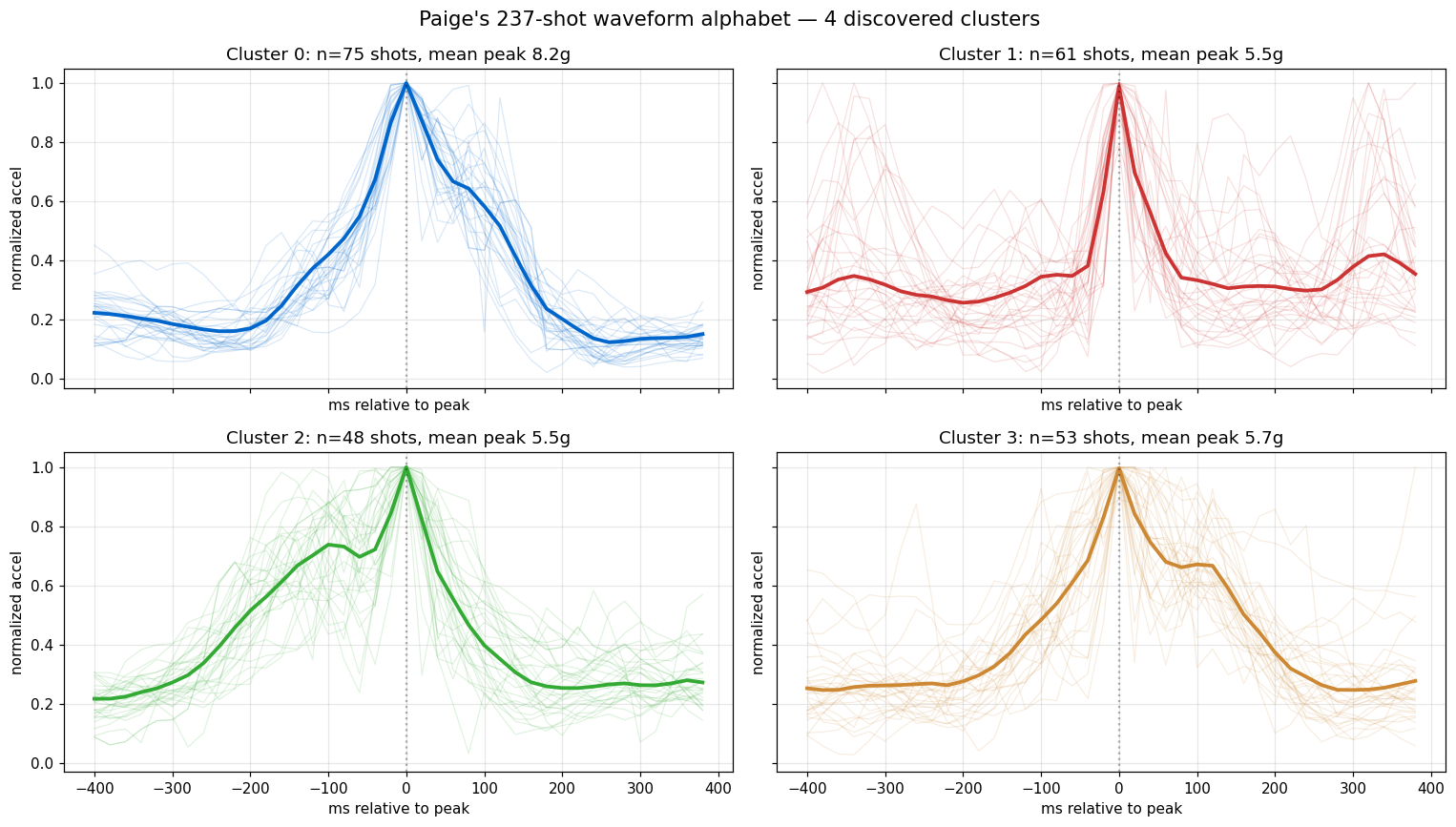
We didn't tell the model what a dink or a drive looks like. We ran unsupervised clustering on 237 of your wrist waveforms and four acceleration fingerprints emerged. The labels below are our best guesses — tell us which ones match how you actually played them.

Four clustered shot waveforms auto-discovered from 237 of your shots
Each panel shows all 30+ shots in one cluster (faint lines) and the cluster centroid (bold). X-axis = 800ms window around peak contact. Y-axis = normalized acceleration.
Cluster 0

Hard drives (our guess)

75 shots
Sharp symmetric peak at 8.2g mean — the highest of any cluster. Rise ~85ms, fall ~115ms. These are your power moments — body engaged, clean force.
Signature: · peak 8.2g · dur 200ms
Cluster 1

Quick dinks & volleys (our guess)

61 shots
Tight narrow peak — fastest in/out of any cluster. Rise 44ms, fall 58ms. The kitchen touch shots — compact, no wind-up, no follow-through.
Signature: · peak 5.5g · dur 101ms
Cluster 2

Loaded shots (serves? backhand setups?)

48 shots
Slow 155ms rise, sharp 71ms fall — the wind-up signature. Your arm loads before release. Most likely serves or high backhand setups.
Signature: ╱│ · peak 5.5g · dur 226ms
Cluster 3

Trailing-finish shots (backhands? transitions?)

53 shots
Asymmetric — rise 93ms, fall 122ms. The lingering-finish pattern. Possibly backhand drives, or shots played from the transition zone.
Signature: │╲ · peak 5.7g · dur 214ms
Why this matters to you

No other consumer pickleball wearable does this. Once you label a handful of shots ("this was a serve, this was a dink"), the app learns your personal shot alphabet and tracks how each evolves session by session. Next week you'd get coaching like "your serves got 12% faster — what did you change?" instead of just "you hit 98 shots."

02 · Form signatures

What your wrist hints at about your form.

The wrist sensor can't see your paddle face or grade technique the way a coach watching from the sideline can. But the SHAPE of each swing signature tells us something about how you're generating force. Here's what we can honestly read, and what still needs a video.

Your loaded shots (Cluster 2, ~48 shots)

You're actually winding up — that's good.

Your Cluster 2 signature has a 155ms rise followed by a 71ms fall. That's a 2.2:1 load-to-release ratio — meaningful wind-up followed by committed finish.

Most rec players have near-symmetric signatures on serves (just swing at it). Yours shows you're building momentum through the arm before release. If these are your serves, that's real serve form, not just a tap.

Needs video to confirm: the SOURCE of the load (hip rotation vs shoulder-only) — but the load itself is there.
Your hard drives (Cluster 0, ~75 shots)

Your drive finish is committed.

Rise 85ms, fall 115ms. Your fall time is ~35% longer than your rise. That's a follow-through signature.

If you were arming the ball — swinging from the shoulder only and stopping on contact — we'd see a fast rise and an equally fast stop. Your longer fall means your paddle keeps moving past contact. That's body-driven force, not arm-only.

Needs video to confirm: whether the follow-through is directional (forward = good) or wristy (across = less good).
Your dinks & volleys (Cluster 1, ~61 shots)

Your hands are quiet on touch shots.

44ms rise, 58ms fall. No wind-up, no follow-through. Pure reactive paddle use. That's the signature of hands that are already in front of you, not swinging through the ball.

This is GOOD. Rec players often "swing" their dinks, which shows as a wider signature with a bigger decay. Yours are narrow = committed kitchen stance, paddle out in front.

Needs video to confirm: paddle face angle (closed/open) on your dinks — the sensor can't see this.
Your trailing-finish shots (Cluster 3, ~53 shots)

Something is different about this group.

Rise 93ms, fall 122ms. The asymmetry is stronger than your hard drives. Long decay after contact — paddle keeps moving well past the ball.

Plausible reads: (1) these are backhand drives with extended finish, (2) you're reaching for balls out of your strike zone, (3) these are shots played on the move rather than set. In pickleball, the tell of a reaching shot is usually the trailing decay — paddle continues because your body wasn't positioned to stop it cleanly.

If you can tell us "these were my backhands" OR "I was stretched out a lot" — we can train the detector to confirm.
Your overall form signal

Across 237 shots the top-5 nearest-neighbor similarity averaged 0.97 — which means the motor programs you're running are extremely consistent. You're not flailing differently every swing. Your body knows four patterns and executes them repeatably. That's the baseline condition for any real coaching to work.

What the wrist can never tell you
• Paddle face angle at contact (open/closed)
• Contact point on the paddle
• Spin magnitude in RPM
• Where on the court you stood
• Your split-step timing
• Your grip (Continental, Eastern, etc.)
For those we need either a paddle sensor or a phone video paired to the IMU. Both on the roadmap.
03 · Your rallies, per YOU

Important context: you see only your shots.

In a doubles rally, 4 players are on court but only your wrist has a sensor. The PPA pro tournament stat of 11.5 shots per rally counts shots from all 4 players. Your 2.9-shots-per-rally average is just the shots YOU struck — your partner + your opponents struck the rest. If we assume roughly balanced doubles participation, a ~3 shots-per-rally from you = a total rally of ~8-12 shots across all 4 players. That's actually a healthy rally length.

Session 1 — how often you struck in each rally (12s gap threshold, beta)
1 (your serve/return)
46
2–3 strikes
50
4–5 strikes
13
6–8 strikes
1
9+ strikes
1
You struck 2.9 shots per multi-shot rally on average. In doubles that implies real rallies totaling ~8-12 shots — pretty normal rec-competitive shape. The few 4-5 strike rallies (13 of them) are where you stayed engaged for more touches in a single point. Our detector is still in beta; if you remember a 20-shot dink battle that didn't show up, the threshold is probably splitting it.
Your biggest rally
9
of your strikes in 8 seconds
At minute 24 you personally hit 9 shots in 8 seconds — about one per second. That's a dialed-in kitchen volley exchange. Total rally including your partner and opponents was probably 15+ shots. HR was in the 130s; you were locked in.
Session 1 · 23:54 → 24:03
04 · Watched happen

A 6.5-minute rest quietly changed your game.

At minute 33 you took a 6.5-min break. Your HR dropped to 108. When you came back, the stats say "same pace" — 57 shots vs 57 shots, nearly identical peak G. But something shifted underneath.

Before rest (min 20–33)
Shots57
Peak G avg6.28
HR avg119 bpm
Dinks20
Drives27
Hard drives10
Smashes1
Your hardest shot14.0g
6.5-min rest
HR 131 → 108
After rest (min 39–52)
Shots57
Peak G avg6.25 (−0.5%)
HR avg127 (+8 bpm)
Dinks16 (−4)
Drives34 (+7)
Hard drives7 (−3)
Smashes0 (−1)
Your hardest shot9.8g (−30%)
What the headline misses: you replaced dinks AND hard drives with middle-ground drives. Your hardest shot dropped 30%. Your heart worked 8 bpm harder for the same average force. Either you consciously shifted to a more sustained grinding style — or the rest gave you cardio recovery while your neuromuscular system quietly slipped into fatigue. Either read is coachable. Do you remember feeling any different after the break?
Why this matters

Real coaches watch the game. Wearables watch YOU. Same-player, same-session, quantified pre/post comparisons are the thing only a wearable can do at 50Hz resolution. This is the daily coaching moment — your 14.0g swings disappeared after the rest; your cardio went up 8 bpm — that tells you something about your own body your opponent never saw.

Your top priority next session · synthesized from 3 AI coaches in parallel

Rebalance your shot diet — more dinking, fewer drives.

You hit 167 drives vs 104 dinks across both sessions — drives outnumbered dinks almost 2:1. A common coaching principle: establish a sustained dink exchange before you speed the ball up, rather than attacking on the first attackable ball. You're not wrong to drive — you're just not building enough dink pressure first.

Your drill
10 min of cooperative cross-court dinking before games (aim for 30+ shot rallies, no drives allowed). Then play points where you or your partner must hit 3+ dinks before anyone can speed up.
How to measure it
Your longest rally should grow past 9 strikes of yours. Your Cluster 1 volume (quick dinks) should increase from 61 toward 90+ in a similar session. Your dink % should rise from 31 toward 40.
Your shot mix today
Dinks31%
Drives49%
Hard drives19%
Smashes1%
Only 2 shots above our 12g smash threshold — could mean high-percentage play, or our threshold is too high for your smashes. Do you remember your hardest overheads today?
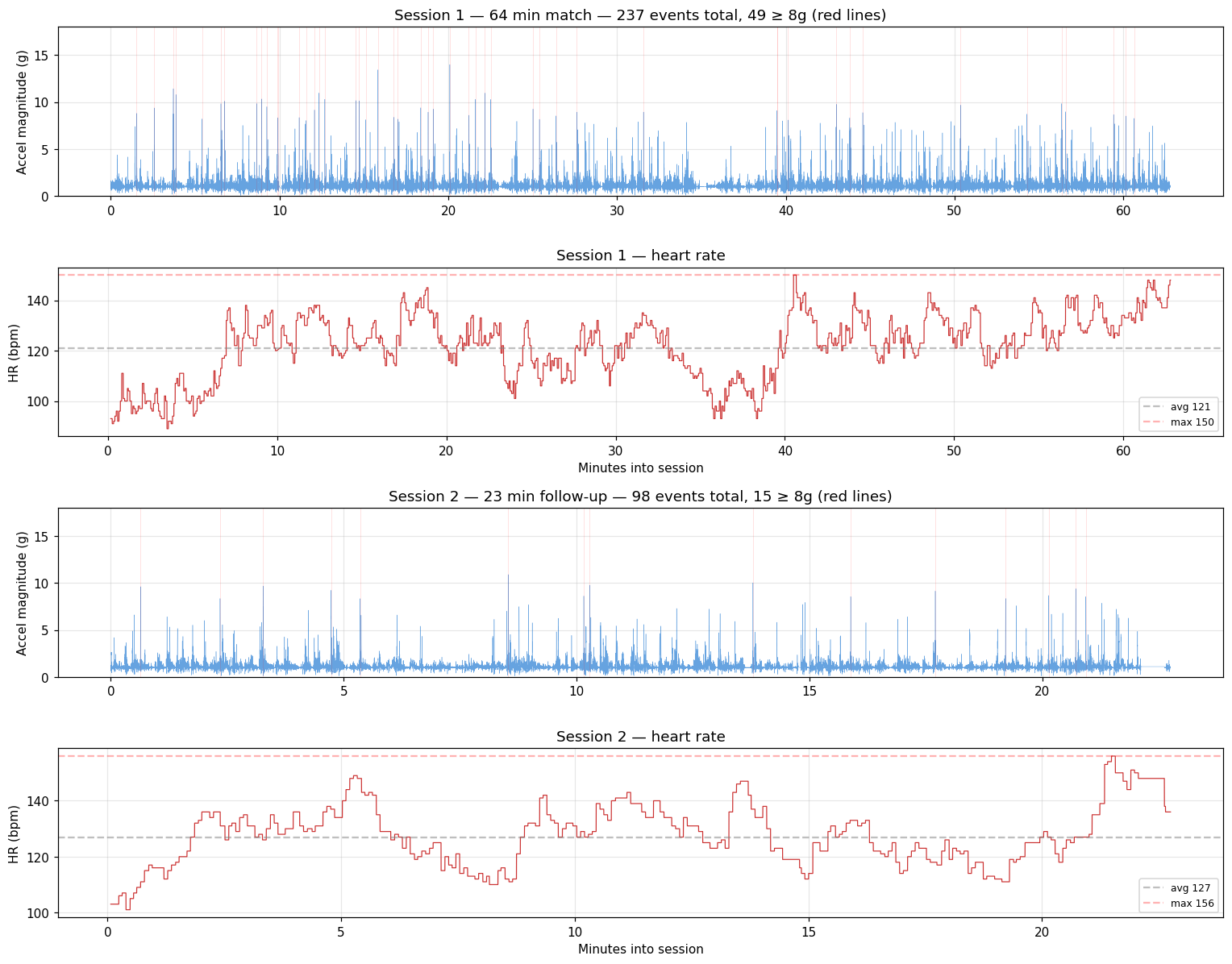
Your full session · accel + heart rate
Timeline of accel magnitude and heart rate across both your sessions
Top/third panels — wrist acceleration magnitude in g. Each vertical spike is a shot. Bottom/fourth panels — your heart rate across session. Session 1 shows the mild fatigue decline; Session 2 shows the reversal with late HR spike to 156 bpm.
How your coaching was generated

Your coaching wasn't written by one AI. Your session data was sent in parallel to three different models. All three converged on the primary coaching (dink more, drive less). Unique insights from each were combined.

Gemini 3.1 Pro
Framed your session 2 as "second wind / accessing reserve." Noted the 10 back-to-back drives as abandoning the soft game.
DeepSeek V3.2
Flagged the delayed cardio spike as possible leg fatigue. Suggested "one extra dink before driving" as the rule.
Claude Sonnet 4.6
Spotted the incomplete HR recovery (89 → 101 baseline). Flagged 74-min break may not be enough between double sessions.
Praise earned

335 tracked shots in 87 minutes is legit work, Paige. You didn't mail it in, you didn't quit early, and that Session 2 comeback after a long break shows mental toughness. A lot of rec players would've packed it in after Session 1. You came back and hit harder.

Methodology
Data
Apple Watch Series 10, 100Hz 9-axis IMU filtered to 50Hz, stored in WR1 binary format. HR via HKWorkoutSession. GPS via watch. Events defined as ≥4g peak wrist acceleration with 400ms debounce.
Shot vocabulary
Unsupervised K-means (k=4) on 800ms-normalized accel magnitude waveforms. No shot labels used. Cluster interpretations are post-hoc based on signature shape + peak G.
Rally detection (beta)
Your shots within 12-second gaps grouped as same rally. Single-shot "rallies" likely serves or isolated returns. Only your shots are tracked — in doubles, ~¼ of total rally shots.
Coaching discipline
Claims labeled SENSED (direct measurement) vs INTERPRETED (possible meaning, alternatives listed). No technique claims from wrist alone — the sensor can't distinguish athletic from uncoordinated motion without video.